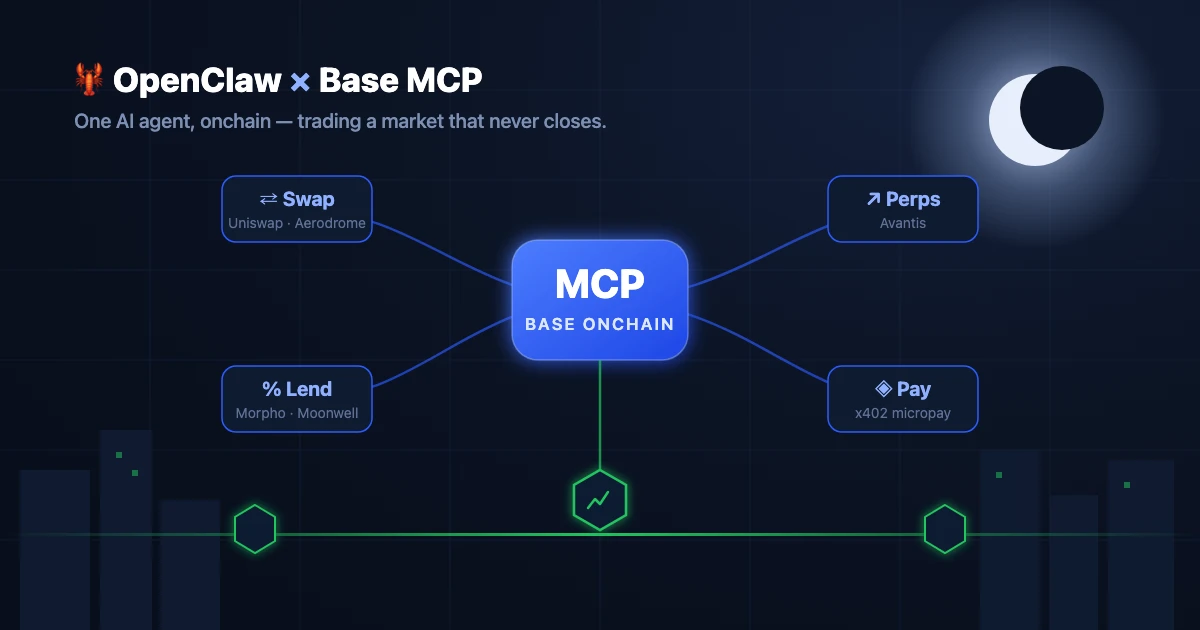
Coinbase spent 2026 turning its Base network into a place where the customer doesn't have to be human. On May 26, 2026, Base shipped Base MCP — a gateway that lets an AI agent like Claude or ChatGPT hold a wallet, swap tokens, supply to lending vaults, and settle payments directly on an onchain market that never closes. By late June the connector reached 13 major Base apps, and Base head Jesse Pollak told Coinbase's keynote that roughly 90% of agent payments already settle on Base. This guide walks the whole setup: sign up for OpenClaw Direct, give your agent a self-custody wallet, wire in the Base MCP, and bolt on the guardrails a 24/7 DeFi market actually demands before a single token moves.
Why a 24/7 Onchain Market Needs a Hosted Agent
Base is an onchain market, which means it has no opening bell and no last call. Bitcoin and Ethereum trade on it around the clock — Pollak claims Base is the largest onchain venue for spot BTC and ETH, at 44% of all Bitcoin spot exchange volume — and the DeFi positions your agent might manage accrue interest and drift toward liquidation every second, not just during business hours. A rebalance you miss at 3am is a real cost, not a missed message. So where does an always-on agent actually live?
Not on your laptop. The moment your machine sleeps, your agent stops watching a market that doesn't. Worse, Base MCP hands your agent a wallet, and that wallet's private key has to live somewhere. If it sits in a config file on the same laptop you browse with, a stolen or compromised machine is a drained wallet — no OAuth revoke, no customer support, no chargeback. Onchain is unforgiving in a way a brokerage account isn't.
OpenClaw Direct is built for exactly this shape of problem. Every Instance runs on its own dedicated machine, isolated from every other user, with your wallet key encrypted at rest and in transit inside the platform's credential vault instead of a file on your hardware. The infrastructure holds 99.9% uptime with 24/7 monitoring, so your agent stays online while you sleep or travel, and you can suspend or terminate it from any browser on any device. For software that signs onchain transactions with real money, that's the correct amount of surface area — and the correct amount of blast radius.
What Is Base MCP, Exactly?
Base MCP is a single connector that exposes onchain actions to an AI agent through the Model Context Protocol — the same open standard Robinhood, Kraken, and OKX all adopted in the same 90-day window. Per CoinDesk, it lets agents "manage crypto wallets and DeFi apps" on Base directly, with no bespoke integration code. You don't write a Web3 SDK against six protocols. Your agent connects to the MCP, and the MCP tells it which onchain tools it's allowed to call.
If you've read our explainer on MCP, the pattern is familiar: one server, a menu of tools, a standard handshake. What makes the Base version distinct is that the tools reach into DeFi. At launch, Fortune reported integrations with lending markets Morpho and Moonwell, decentralized exchange Uniswap, and perpetuals venue Avantis — with the app list growing to 13 by late June. Your agent isn't just placing spot orders. It's supplying collateral, opening liquidity positions, and managing leverage, all through conversation.
The second half of the story is x402, Coinbase's HTTP-native micropayment protocol. It revives the dormant "402 Payment Required" status code so an agent can pay for an API call — a data feed, a research report, a premium endpoint — in fractions of a cent of USDC, automatically, per request. The Next Web framed the combination as an agent that can "trade and pay for research on your behalf." The x402 spec is open source and has since moved to its own foundation, which is why so much of the agent ecosystem settles on Base.
What Can Your Agent Actually Do on Base?
At launch, agents can reach spot crypto and derivatives on Base, with equities and prediction markets on the near-term roadmap, per TechCrunch. That's a wide surface for a connector that's only weeks old, so it's worth being concrete about the categories before you point an agent at any of them.
- Spot swaps. Buy and sell BTC, ETH, and Base-native tokens through Uniswap or Aerodrome — the bread-and-butter action, and the right place to start.
- Lending and yield. Supply assets to Morpho or Moonwell vaults to earn, or borrow against collateral. Powerful, and the fastest way for a careless agent to open a liquidation risk.
- Perpetuals. Leveraged positions on Avantis. This is the sharpest tool in the box; keep it out of your agent's hands until you deeply trust its judgment.
- Agent payments. Pay for data and premium APIs per-call via x402, so your agent can buy the research it needs to make a decision.
Notice the risk gradient. A bad spot swap costs you the spread. A bad leveraged position, or a lending vault that gets liquidated in a flash crash, can cost you the whole balance — and onchain, there's no circuit breaker to pause the damage. The safety skill in Step Four exists to keep your agent on the left end of that gradient until you've decided, with evidence, to let it move right.
First, the Wallet — and the Honest Risk
This is the step that makes Base different from every brokerage setup we've written, so read it before you fund anything. Robinhood's agentic trading uses OAuth against an account Coinbase-style custody holds for you; Base MCP is self-custody, meaning your agent operates a real onchain wallet whose private key controls real funds. There's no "disconnect" button that claws back a bad transaction. Once a transaction confirms onchain, it's final.
- A dedicated hot wallet, funded low. Create a fresh wallet just for the agent. The balance in it is the absolute maximum the agent can lose, so treat it like the cash you'd carry in a risky neighborhood — enough to work, not enough to hurt.
- Cold storage for everything else. Your main holdings stay in a wallet the agent has no key to. Never give an agent the keys to your life savings; give it an allowance.
- USDC on Base for gas and swaps. Fund the hot wallet with USDC (and a little ETH for gas) on the Base network specifically — not Ethereum mainnet, not another L2.
- Region and KYC. DeFi access on Base is broad, but Coinbase's own custodial rails and some app front-ends apply regional restrictions. Confirm what's available where you are before you rely on it.
- An honest read on finality. You're authorizing software to sign irreversible transactions in a market with no closing bell and no undo. Fund the wallet with an amount you're fully prepared to lose.
The Setup, Step by Step
Step One: Sign Up for OpenClaw Direct and Provision Your Instance
Go to openclaw.direct/users/sign_up and create an account. The Advanced plan ($29/month, "Most Popular") is the right starting point for trading workloads — 4 GB of dedicated RAM and unlimited AI models, so you're not rationing calls while your agent watches an around-the-clock market. Every subscription includes free trial credits, enough to wire the whole thing up and watch a few actions before you commit. Create a new Instance, name it something like "Base Agent," and click "Start Provisioning." While it builds, move to Step Two.
Step Two: Create and Fund a Dedicated Wallet
Create a fresh wallet for the agent — either a standalone key you'll store in the OpenClaw Direct credential vault, or a Coinbase Developer Platform (CDP) server wallet, which is the smoother path because it's built for programmatic signing and supports policy controls. Fund it on the Base network with a modest amount of USDC plus a little ETH for gas. This wallet's balance is your real circuit breaker: in a market with no daily loss limits, the only hard cap that always holds is the money the agent can physically reach. Size it like a stake you'd be annoyed to lose but wouldn't need to rearrange your month over.
Step Three: Wire the Base MCP Into Your Instance
With your Instance provisioned, add the Base MCP to its MCP server list. Base publishes the connector and its configuration through the Coinbase Developer Platform docs; you point your agent at the server and supply the wallet credential you created in Step Two. On OpenClaw Direct that credential is held in the encrypted vault, scoped to your Instance, never written to a personal disk. The MCP is model-agnostic — Base built it to work with Claude, ChatGPT, and any MCP-compatible agent — so you're not locked to one provider. Once connected, your agent can see the onchain tools it's allowed to call. It just shouldn't call any of them yet.
Step Four: Attach a Safety Skill (Don't Skip This)
Wiring the MCP gives your agent the capability to move funds. It does not give it the judgment to move them well. Before it signs a single transaction, attach a small persistent safety skill to your Instance from the Skills card. A sensible Base starting set:
- A per-transaction USDC cap and a rolling daily volume cap.
- A token whitelist — only assets you actually want traded (e.g. ETH, USDC, a short list of blue-chips), nothing your agent discovered in a chart.
- A protocol whitelist — spot swaps allowed, lending gated behind approval, perps banned outright while you're learning the agent's behavior.
- A slippage ceiling and a minimum-liquidity floor, so the agent won't trade into a thin pool and eat a terrible price.
- A rule to read the wallet balance and open positions before any action, to avoid duplicate or over-leveraged trades.
This lives in a skill, not a chat instruction, because chat instructions vanish when the agent's memory is compacted — persistent rules belong in persistent files. It's the same pattern we cover in how to structure your AGENTS.md: a skill survives every conversation, restart, and model swap. Onchain raises the stakes on this, because the market that would let a bad rule run wild never closes to give you a breather, and every mistake is final.
Step Five: Start Read-Only, Then Add Approvals
Give your agent a bounded first task that moves nothing. From the OpenClaw Direct dashboard, ask it to read the wallet's balances and open positions, pull current Base market context, and write a short brief on what it would do if it were trading. This costs almost nothing — a little gas at most for reads — exercises the MCP end to end, and shows you how the agent reasons before it can act. Run that loop a few times. Sensible briefs are evidence the tools work; nonsense briefs catch a problem before any money moves.
When you graduate to live actions, keep a human in the loop. Wire a Telegram approval on every transaction so you get a preview — token, action, size, estimated price — with confirm and reject buttons before anything signs. Then keep the first real task tiny: tell the agent to swap a fixed, small amount of USDC into ETH and back. That exercises signing, the approval flow, and balance reading in one round trip, with the worst case being a couple of dollars of spread on a blue-chip. From there you can expand into scheduled dollar-cost averaging or a lending position — see scheduling agent cron jobs — with confidence the plumbing holds.
What Happens When Something Goes Wrong
Every serious agentic setup has to answer one question: when your agent does something you don't want, how fast can you stop it? Self-custody changes the honest answer, and you should know it going in.
Your fastest kill switch is the OpenClaw Direct dashboard: suspend or terminate the Instance from any browser, on any device. Suspending stops the agent and pauses its compute; terminating wipes the Instance. Because the agent's wallet key lives in the platform vault rather than on your laptop, killing the Instance means no process can sign a new transaction — that's the platform-level revocation that makes hosting worth it. If you're traveling with only a phone, it still works.
The harder truth is what a kill switch can't do. Onchain, a transaction that already confirmed is final — there's no Robinhood-style disconnect that cancels in-flight orders, and no venue that will reverse a bad swap. A poorly configured agent in a flash crash can sign a trade a human would instinctively avoid, and Base has no circuit breaker to buy you time. This is why the wallet balance, not the kill switch, is your real limit on the downside, and why the safety skill's caps and whitelists do the heavy lifting. For a fuller reckoning of where models actually fall short with money on the line, we wrote what AI still can't do in markets. The rule that matters most stays simple: don't fund the agent's wallet with more than you can lose without rearranging your life.
Where to Go From Here
The plumbing is finally there. The largest onchain venue in crypto now has an officially supported way to let an AI agent trade spot, work DeFi, and pay for its own data through a single MCP connector — and it works with whichever model you already trust. The remaining work — which protocols to use, how to size positions, how to grow your trust over time — is the same work any onchain trader does, and the right way to build those instincts is small stakes over a few weeks with read-only reports and Telegram approvals. This is the same architecture every serious venue converged on; we walked through the brokerage version in setting up OpenClaw to trade on Robinhood and the crypto extension in Robinhood's agentic crypto setup.
All of it depends on an agent that's actually online when the market is — which, onchain, is always — and that keeps its wallet key somewhere safer than your laptop. That's why we built OpenClaw Direct: a dedicated Instance for every user, encrypted credential storage, 99.9% uptime, a dashboard kill switch reachable from any browser, and automatic platform updates so the infrastructure under your agent stays current without you maintaining it. Free trial credits come with every subscription — enough to wire up Base end to end and watch your first few actions fire.
Ready to run a 24/7 onchain agent?
Start with OpenClaw Direct. Free trial credits included with every subscription.
Run OpenClaw NowSources: Base Blog — Introducing Base MCP: Your Agent's Gateway to Base, CoinDesk — Base Launches AI Tool for ChatGPT to Manage Wallets and DeFi, Fortune — Coinbase Pushes Further Into AI Payments With Base MCP, TechCrunch — Coinbase's New Tool Can Help Agents Trade and Pay for Research, The Next Web — Coinbase Launches an AI Agent That Can Trade and Pay, Coinbase Developer Platform — MCP Server with x402, and GitHub — coinbase/x402 (payments protocol for the internet).